
Ranthambore is best known for its tigers, but it is also one of India's great places for birdwatching. If you are looking for the birds of Ranthambore National Park, this beginner's checklist covers the species you are most likely to see, where to look, and when to go.
Quick answer
Sources give different totals for the park's birds, with counts from about 270 to around 320 species, including residents and migrants. Many species are visible all year, while winter brings water birds, ducks and migratory visitors. Binoculars make the biggest difference on any safari.
How many bird species live here?
Counts differ by source, because the park's records keep growing as birders report new sightings. Either way, Ranthambore is a major birding destination in Rajasthan. The park is also home to many mammals and reptiles, so a bird-focused trip still gives you a full wildlife experience. Our history, zones and wildlife guide gives the bigger picture. If you also want to learn about the animals that share the forest, read about the famous tigers of Ranthambore and our tigers of Ranthambore guide.
Common birds you are likely to see
- Indian Peafowl: often seen near forest edges and open grass.
- Rufous Treepie: a noisy, active bird that is easy to spot in trees.
- Red-vented Bulbul and Indian Robin: frequent forest birds that are easy for beginners.
- Plum-headed Parakeet: green parakeets that move in small flocks.
- Crested Serpent-Eagle: a large raptor often seen perched on branches.
- Painted Francolin: a shy ground bird of dry forest and grassland.
- Indian Paradise Flycatcher: a striking bird, most easily spotted in the forest canopy.
Migrants and winter visitors
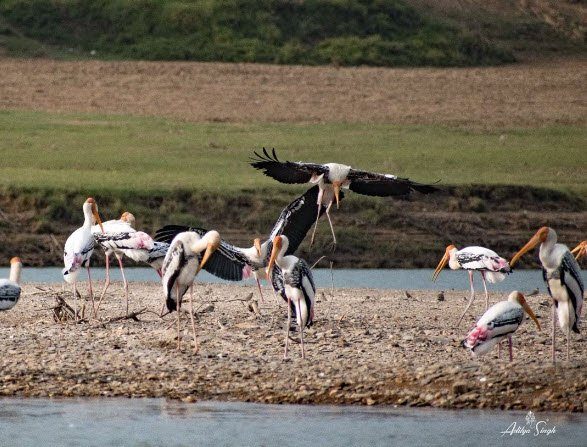
Winter is the best season for water birds. Lake and wetland areas can hold storks, egrets and herons, along with ducks, geese and waders. Among the migrants reported for the park are Painted Stork, Greater Flamingo, Eurasian Spoonbill, Sarus Crane and Demoiselle Crane. The outer routes are good for seasonal birds, so compare them in our zones 6 to 10 safari guide.
Rare and special birds
Some species are rare, and seeing them is a bonus rather than a promise. Reported highlights include Brown Fish-Owl, Painted Sandgrouse, Indian Skimmer and Pallas's Fish-Eagle. Two vultures found here, the Indian Vulture and the Red-headed Vulture, are listed as critically endangered. If you spot one, keep a respectful distance and do not disturb it.
Where to look: zones and lakes
The best zone for Ranthambore safari guide explains the core routes. For birds, the outer zones are worth a look. Zone 9 follows the Chakal river, known for aquatic birds, and zone 10 is strong for birdwatching, especially in winter. Our full Ranthambore National Park page has the park overview if you are planning the route.
When to go
Winter gives the widest range of species, because resident birds are joined by migrants and the weather is comfortable on early drives. Our best time to visit Ranthambore guide compares the seasons. Check the park timings and closing days before you fix a date, because zones 1 to 5 and zones 6 to 10 have different closing days.
What to bring for birdwatching
Binoculars are the most useful item. Many birders recommend 8x42 or 10x42 models for forest light. If you want photos, a telephoto lens helps, and our safari gear checklist lists what to pack. For camera rules and settings, read our tiger photography tips.
Birdwatching etiquette on a safari
Stay seated in the vehicle, keep voices low and avoid sudden movements. Do not ask your driver to chase a bird off the track. Other guests share the same road, so give everyone a clear view. A calm, patient drive gives you more sightings than a noisy one.
Choose the right vehicle for birds
A Jeep (6 seats) gives you more flexibility to stop when a bird appears, which many birders prefer. A Canter (20 seats) is a budget-friendly option for groups. Our Jeep vs Canter safari guide compares both in detail. Birds are a strong reason to compare our safari packages for a longer morning drive.
Plan your bird-focused trip
Book through our Ranthambore safari booking guide, read how to reach Ranthambore National Park, and look at hotels and resorts for a stay close to the park. Our jungle safari bucket list has more ideas for what to spot on every drive. If you want to know which famous animals share the forest, see what Ranthambore National Park is famous for.
Have a question?
Our team can help you plan a morning safari that suits birdwatchers. New to the park? Start with our Ranthambore safari tips for first-timers. Contact Wildaddis for advice, or see our Ranthambore blog for more guides.